|
|
|
|
|
Character |
Dialogue |
|
|
Teacher:
|
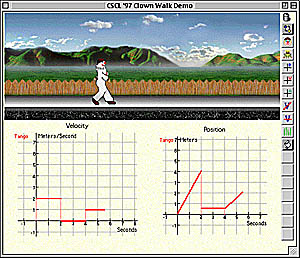
Now there is something I have been wondering about. Can I show a position graph that is linked to the velocity graph? |
|
|
Mentor: |
Sure... in fact I'm pretty sure that Jeremy has a script to do that and we are in his "open office hours" now. |
|
|
Teacher: |
Who's Jeremy? |
|
|
Mentor: |
Oh, of course you wouldn't know
that... he's the designer of MathWorlds, and he works at the University
of Massachusetts, San Francisco campus. Let's page him and see if
he is in his TAPPED IN office to join us.... |
|
|
Narrator: |
In the process of tailoring
that teachers need to carry out to make technology innovations their
own, suited to their tasks, an extended community--a "knowledge
network"--can be brought together virtually. This knowledge
network includes developers, resource "brokers" like the
Math Forum mentor we have on-line, other teachers, and learning
researchers who are studying the processes of how better to support
teacher learning and tailoring for educational reforms. |
|
|
Jeremy: |
Hi, David! Who do you have with you today? |
|
|
Mentor: |
I have a teacher here, Al Gore, from Clinton Middle School. |
|
|
Jeremy: |
Hi Al. Welcome to the Land of Make Believe. Oh, I mean the San Francisco campus of the University of Massachusetts, home of the SimCalc Project. |
|
|
Mentor: |
We were wondering if you have a script for hiding and showing a position graph. |
|
|
Jeremy: |
Well, actually I do. I'll send it to your "in box," and you can just drop it into your toolbar. |
|
|
Teacher:
|
I got it |
|
|
Narrator: |
The activities we have just
seen presuppose a future in which software component architecture
such as Java is commonplace, where high quality Internet-based educational
objects of all kinds are available over the Web for teachers' use.
These ideas are not a fantasy. In pilot work, Roschelle and others
recently demonstrated a suite of 22 components that can be mixed
and matched for teaching the mathematics of motion (e.g., graphs,
tables, notebooks, simulations, Web browsers) from five geographically
distributed developers, showing the feasibility of component software
development for education. |